
Home › Blog › Root Canal or Extraction?
Restorative DentistryRoot Canal or Extraction?
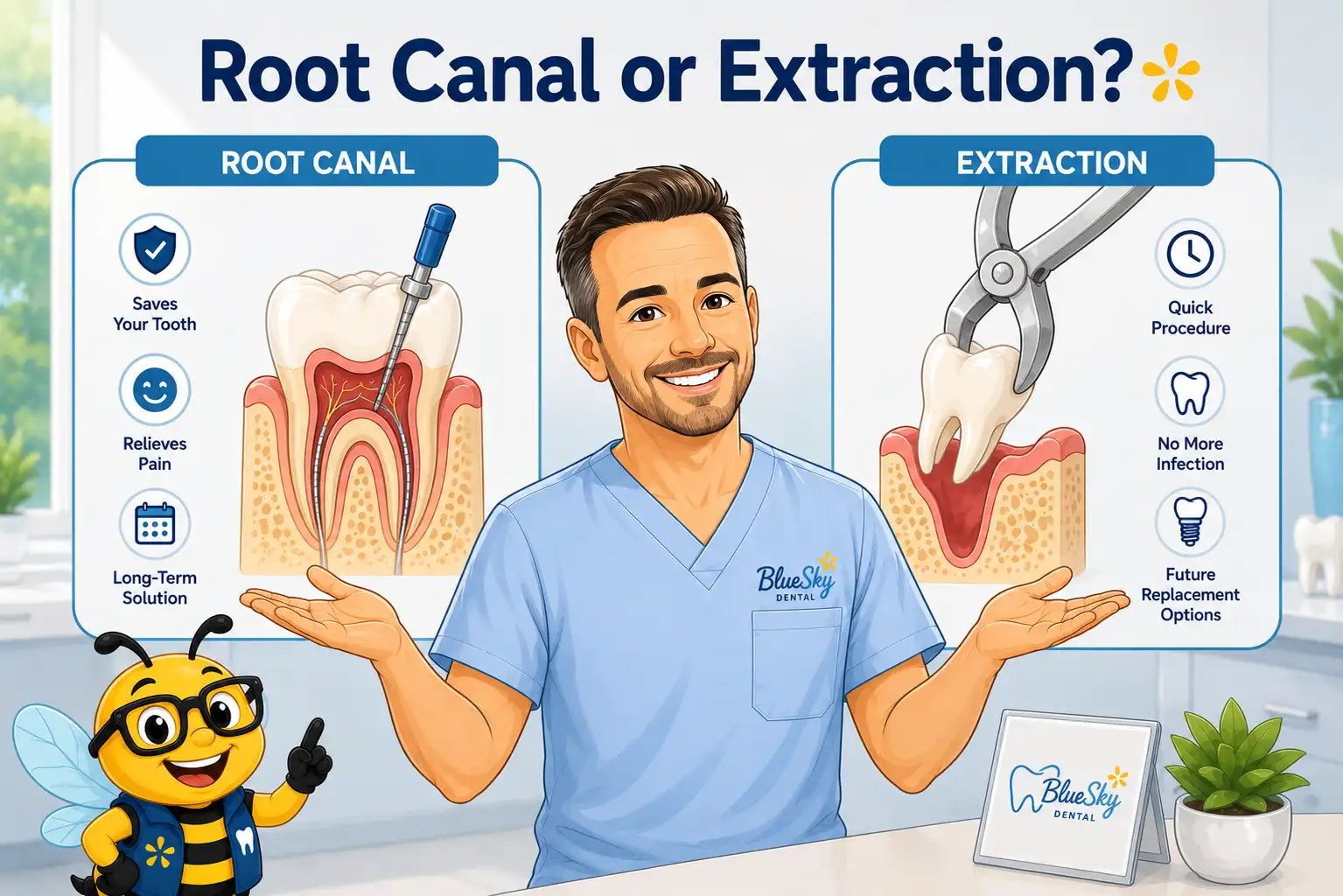
"Should I Save It or Pull It?" - The Most Common Question in Dentistry
Few dental decisions feel as weighty as the one between saving a damaged tooth with a root canal and having it removed entirely through an extraction. It's a question our Ottawa dental practice hears almost daily, and the answer is rarely as simple as one option being universally better than the other.
The right choice depends on the specific condition of the tooth, the health of the surrounding bone and gum tissue, your overall medical history, and - let's be honest - your budget and long-term goals. What we can say with confidence is that modern dentistry has made both options more predictable, more comfortable, and more successful than at any point in history.
This guide walks you through how dentists evaluate the decision, what each procedure actually involves, and the real long-term costs of both paths. Our goal isn't to push you toward one treatment or the other - it's to help you make an informed choice you'll feel good about years from now.
How Your Dentist Evaluates the Tooth
Before recommending a root canal or an extraction, your Ottawa dentist conducts a thorough assessment that considers multiple factors. This evaluation typically includes clinical examination, diagnostic imaging, and a frank conversation about your priorities.
The key factors that guide the decision include:
- How much healthy tooth structure remains. A tooth broken at or below the gumline, or hollowed out by extensive decay, may not have enough solid structure left to support a crown.
- The extent and location of the infection or decay. Infection confined to the pulp can usually be treated, while decay that reaches deep below the gum is far harder to restore.
- Whether the tooth is cracked, and how deeply. A vertical root fracture typically can't be repaired, whereas a crack limited to the crown often can.
- The health of the surrounding bone and gums. Advanced gum disease can loosen a tooth to the point where saving it is no longer realistic.
- Whether a previous root canal has failed. Some retreatments succeed, particularly with a microscope, while others signal that the tooth has reached the end of its life.
- Your overall health and the tooth's role in your bite. Your medical history, and how important the tooth is to chewing and alignment, both shape the recommendation.
What a Modern Root Canal Actually Involves
The reputation root canals carry - as painful, dreaded procedures - belongs to a different era of dentistry. Today's root canal therapy is precise, efficient, and, for most patients, no more uncomfortable than having a filling placed.
The procedure involves removing the infected or damaged pulp (nerve tissue) from inside the tooth, cleaning and shaping the root canals, disinfecting them thoroughly, and sealing the space with a biocompatible material. What's changed dramatically in recent years is the technology behind each of these steps.
At BluSky Dental, complex root canals benefit from microscope-assisted endodontic treatment. A dental operating microscope provides up to 25x magnification, illuminating every curve and branch of the canal system. This level of detail allows the dentist to locate and treat canals that would be invisible to the naked eye - small accessory canals that, if missed, can harbour bacteria and lead to treatment failure.
Additional technologies that improve outcomes include electronic apex locators (which precisely determine canal length without relying solely on X-rays), rotary nickel-titanium instruments (which navigate curved canals more safely than traditional stainless-steel files), and ultrasonic irrigation (which flushes bacteria from microscopic tubules within the tooth).
After the root canal, the tooth will need a permanent restoration - most commonly a dental crown - to protect it from fracture. A root-canal-treated tooth without a crown is significantly more likely to crack during chewing, which would then require extraction. Think of the crown as the essential second half of saving the tooth.
When Extraction Is the Better Choice
Preserving natural teeth is almost always the preferred approach, but there are genuine clinical scenarios where extraction is the smarter long-term decision:
- Decay too extensive to restore. When decay is too advanced for a filling, crown, or root canal, removing the tooth prevents the infection from spreading.
- A vertical root fracture. Some fractures extend too deep to repair, and a tooth cracked down the root generally can't be saved.
- Advanced gum disease. Periodontal disease can loosen a tooth to the point where no amount of restoration will stabilise it.
- A failed root canal that can't be retreated. If a treated tooth becomes reinfected and retreatment isn't viable, extraction may be the only option left.
- Impacted or problematic wisdom teeth. Wisdom teeth that can't emerge properly are usually best removed.
- Severe crowding. Occasionally a tooth is removed to create space for orthodontic treatment.
The Real Cost: Root Canal + Crown vs. Extraction + Implant
Cost is a legitimate factor in any dental decision, and patients deserve an honest comparison. Here's what the numbers typically look like in Ottawa:
| Option | What it includes | Typical cost in Ottawa |
|---|---|---|
| Save the tooth Root canal + crown |
Root canal therapy to clear the infection, followed by a crown to protect the tooth from fracture. | Crown $1,200 to $2,500. The root canal fee itself depends on the tooth, since front teeth are simpler than molars, and is confirmed at your exam. |
| Replace the tooth Extraction + implant |
Removing the tooth, then placing an implant post and a crown once the site has healed. | Extraction $150 to $300 (simple) or $250 to $500+ (surgical); a complete single-tooth implant $3,000 to $5,000; a bone graft, if the site needs one, $500 to $2,000. |
For most patients, saving the tooth with a root canal and crown carries a lower upfront and lifetime cost than removing it and replacing it with an implant. Most Ontario dental plans also cover 50 to 80 percent of root canal and crown treatment when it is medically necessary, and our team will submit a predetermination so you know your out-of-pocket cost before you commit. The cheapest option isn't automatically the right one, though: a tooth that can't be predictably saved may cost more in repeated treatment than replacing it once, done well.
Why Preserving Natural Teeth Is Usually the Better Outcome
Dental implants are remarkable - they're the closest replacement to a natural tooth that modern dentistry can offer. But even the best implant is still a replacement. Your natural tooth has advantages that no artificial substitute can fully replicate:
- Natural feel and feedback. A natural tooth is held by a periodontal ligament that cushions your bite and senses pressure, something an implant fused directly to bone can't reproduce.
- Preserved jawbone. Keeping the natural root helps maintain the bone that once supported it.
- Stable bite alignment. Holding the tooth in place keeps neighbouring and opposing teeth from drifting out of position.
- Natural appearance. Your own tooth keeps its natural shape, shade, and translucency.
- Better long-term value. Saving the tooth is usually more cost-effective over time than removing and replacing it.
Recognising the Signs You May Need a Root Canal
Not every toothache means you need a root canal, but certain symptoms strongly suggest that the nerve inside a tooth is compromised. If you experience any of the following, don't delay seeking care - early treatment typically means more options and better outcomes.
- A severe, persistent toothache, especially pain that lingers or wakes you at night
- Prolonged sensitivity to hot or cold that lasts well after the food or drink is gone
- Darkening or discolouration of a single tooth
- Swollen, tender gums near the tooth
- A pimple-like bump on the gum that may drain and keep coming back
- Pain when chewing or when you press on the tooth
- Lingering pain in a tooth that was recently filled or crowned
For a more detailed breakdown, read our companion article on the signs you need a root canal.
Making the Decision Together
At BluSky Dental, we don't believe in dictating treatment decisions. We believe in presenting the evidence, explaining the trade-offs honestly, and helping you choose the path that aligns with your health, your goals, and your circumstances.
During your consultation, your dentist will show you your X-rays or 3D images, explain exactly what they see, and walk you through the pros and cons of each option. If a microscope-assisted root canal gives the tooth a strong chance of long-term survival, we'll explain why. If the tooth is compromised beyond the point where saving it makes clinical sense, we'll explain that too - along with your best replacement options, including 3D-guided implant surgery for precise, predictable implant placement.
Our experienced dental team has helped thousands of Ottawa patients navigate this exact decision. We understand the anxiety that comes with it, and we're committed to giving you the time, the information, and the support you need to feel confident in your choice.
Get an Honest Assessment
Whether a root canal can save your tooth or an extraction is the wiser path, BluSky Dental will give you a clear, honest evaluation. Book your appointment today and let's find the best solution for your smile.

Same-Day Dental Crowns in Ottawa
Walk in with a damaged tooth and leave with a permanent crown the same day: how CAD/CAM scanning, in-house milling, and ceramic compare with traditional lab crowns on strength, aesthetics, and cost.
Read more →
Dental Implants in Ottawa
Your Ottawa guide to dental implants: single implants, All-on-4, metal-free zirconia, 3D-guided surgery, realistic costs, and financing.
Read more →
What Is a Dental Crown?
Why crowns are needed, the types available, and what to expect—explained clearly.
Read more →